Background Check Requirements for Cleaning Companies: What Every Homeowner Needs to Know
You’re inviting strangers into your home. That’s not a small thing. Whether it’s a weekly house cleaner or a one-time deep clean, the people entering your space have access to your valuables, your family, and your personal information. Background checks are the single most important safeguard a cleaning company can offer.
But not all background checks are equal. Some companies run a basic name search and call it done. Others run multi-layered criminal, identity, and reference screenings before a cleaner ever sets foot in a client’s home. Knowing the difference protects you.
This guide explains exactly what a thorough background screening process includes, what the industry standard looks like, and what questions to ask before you book.
Key Takeaways
- Criminal history checks should cover at least 7 years and include county, state, and federal records — not just a national database search.
- Identity verification confirms the person being screened is who they claim to be, preventing fraudulent screening results.
- Sex offender and watchlist checks are separate from standard criminal checks and should always be included.
- Employment history verification confirms a cleaner’s experience and flags gaps or misrepresentations.
- Reference checks from previous clients or employers add a human layer of verification that databases cannot provide.
- Third-party screening providers like Checkr, HireRight, and Sterling are more reliable than internal company searches.
- State and federal laws govern what employers can and cannot use in hiring decisions, so compliant screening matters.
What Is a Background Check for a Cleaning Company Employee?
Quick Answer: A background check for a cleaning company employee is a pre-employment screening that verifies identity, criminal history, employment history, and watchlist status. It helps companies confirm that the people they hire are safe to work in clients’ homes and businesses.
A background check is a structured investigation into a person’s past. For cleaning company workers, it serves one core purpose: making sure the people given access to private spaces don’t pose a risk to clients or their property.
Most checks are run by a third-party Consumer Reporting Agency (CRA) — a company that specializes in gathering and verifying background data. The cleaning company pays the CRA to compile a report before making a hiring decision.
The scope of that report varies widely. A bare-minimum check might only search a national criminal database. A comprehensive check will layer in county court records, federal records, sex offender registries, global watchlists, identity verification, and employment history.
The difference between those two levels of screening is significant. National databases are compiled from court records — but they’re often incomplete. County-level records are the most accurate source, and they’re only captured when someone searches them directly.
What Does a Thorough Background Screening Process Include?

Quick Answer: A thorough background screening for cleaning staff includes criminal history at county, state, and federal levels, identity verification, sex offender registry checks, global watchlist screening, employment history verification, and reference checks. Each layer catches what the others might miss.
Criminal History Search
This is the core of any background check. A proper criminal history search covers three levels:
- County criminal records: Searched directly at the courthouse level. Most accurate source. Should cover every county where the applicant has lived.
- State criminal records: Centralized state databases that aggregate county-level data. Coverage and completeness vary by state.
- Federal criminal records: Covers crimes prosecuted at the federal level — fraud, tax evasion, certain drug offenses. Often missed by county-only searches.
Most reputable screening providers search all three. A company that only runs a national database search is leaving significant gaps in its screening process.
National Criminal Database Search
This is often confused with a complete criminal check — it isn’t. National databases are aggregated records pulled from multiple sources, but they’re not updated in real time and they don’t cover every jurisdiction. They’re best used as a pointer to where to search more deeply, not as a standalone check.
Identity Verification
Before any other check runs, you need to confirm the person being screened is who they say they are. Identity verification matches the applicant’s submitted information (name, date of birth, Social Security Number) against authoritative data sources like credit headers and government records.
Without this step, an applicant could use a different name or identity to avoid a criminal record showing up. Identity verification closes that gap.
Sex Offender Registry Check
Sex offender registries are maintained at the state level and are separate from standard criminal databases. A sex offender registry check searches all 50 states plus U.S. territories. This check is not automatic — it must be run intentionally as part of the screening package.
Global Watchlist Screening
Also called a sanctions check or terrorist watchlist check, this screening searches lists maintained by U.S. and international government agencies. Key lists include the OFAC Specially Designated Nationals list, the FBI Most Wanted list, and international law enforcement databases. For most cleaning company hires, hits are rare — but the check takes seconds and carries real weight.
Employment History Verification
This step contacts previous employers directly to confirm dates of employment, job title, and in some cases, eligibility for rehire. It catches applicants who fabricate experience, hide terminations, or misrepresent their work history.
For cleaning companies, employment verification also confirms that a cleaner has the experience they claim. Someone who says they’ve cleaned 200+ homes professionally should be able to provide verifiable employment history.
Reference Checks
Speaking directly with past supervisors, managers, or clients gives context that no database can provide. A reference check surfaces information about reliability, honesty, attitude, and how the person performs in a home environment. Most thorough screening processes include at least two professional references.
What Are the Industry Standards for Background Checks in Cleaning Companies?
Quick Answer: Industry standard background checks for cleaning companies cover 7 years of criminal history, include county and federal records, verify identity, and screen against sex offender registries. Companies using third-party CRAs like Checkr, Sterling, or HireRight align with best practice benchmarks.
| Check Type | Minimum Standard | Best Practice Standard | Common Providers |
|---|---|---|---|
| Criminal History | National database only | County + state + federal | Checkr, Sterling, HireRight |
| Lookback Period | 3-5 years | 7 years (FCRA standard) | All major CRAs |
| Identity Verification | Not always included | SSN trace + credit header match | Checkr, Accurate, IntelliCheck |
| Sex Offender Registry | Single-state search | All 50 states + territories | National Sex Offender Public Website |
| Watchlist Screening | OFAC only | OFAC + FBI + international lists | Kroll, Sterling, Checkr |
| Employment Verification | Self-reported dates accepted | Direct employer contact, 2+ employers | The Work Number, manual verification |
| Reference Checks | Not always included | 2-3 professional references contacted | Conducted by HR or screening vendor |
What Laws Govern Background Checks for Cleaning Company Employees?
Quick Answer: Background checks for cleaning employees are governed by the Fair Credit Reporting Act (FCRA) at the federal level, plus state-specific “ban the box” laws that restrict when and how criminal history can be used in hiring decisions. Employers must get written consent before running any check.
The Fair Credit Reporting Act (FCRA)
The FCRA is the primary federal law governing background checks in the U.S. It sets rules for how Consumer Reporting Agencies collect, use, and share background information. Key requirements include:
- Written authorization from the applicant before any check is run
- Pre-adverse action notice if the company plans to reject someone based on check results
- A copy of the report and a summary of rights given to the applicant
- An adverse action notice if the company proceeds with rejection
The FCRA also sets the 7-year lookback window for most criminal records. Felony convictions can be reported beyond 7 years. Arrests that didn’t lead to convictions are typically limited to 7 years.
State “Ban the Box” Laws
“Ban the box” laws prohibit employers from asking about criminal history on initial job applications. The goal is to give applicants a fair chance before being screened out. As of 2026, more than 35 states and 150 cities have some version of ban the box legislation.
Cleaning companies operating across state lines must understand which rules apply in each location. Some states only restrict the timing of the inquiry. Others restrict how the employer can use the information once obtained.
State-Specific Restrictions on Criminal Records
Several states go beyond the FCRA’s 7-year limit. California, for example, restricts use of certain criminal records regardless of conviction date. New York has specific rehabilitation criteria before criminal history can be considered. Cleaning companies must comply with the most restrictive rule that applies to each hire.
How Do You Verify That a Cleaning Company Actually Runs Background Checks?

Quick Answer: Ask the cleaning company directly which screening provider they use, what components are included, and how often checks are renewed. A credible company can name their CRA, describe the scope of the check, and confirm that every employee — not just new hires — has been screened.
Questions to Ask a Cleaning Company About Their Screening Process
- Which background check provider do you use?
- Does the check include county court records or just a national database?
- Do you verify identity before running the check?
- Is a sex offender registry check included?
- Do you verify employment history for all new hires?
- Are background checks renewed periodically for existing employees?
- Do subcontractors go through the same screening as direct employees?
A company with a strong screening program will answer these questions without hesitation. Vague answers like “we do thorough checks” or “we use industry-standard screening” without specifics are a red flag.
Watch Out for These Screening Gaps
Even companies that claim to screen employees can have significant gaps:
- Database-only checks: No county-level search, meaning recent local crimes may not appear.
- No identity verification: The check runs on unverified information, making it easy to game.
- One-time checks only: An employee cleared at hire but convicted two years later won’t show in a static check.
- Subcontractors excluded: Many cleaning companies use independent contractors who may not go through the same process as staff employees.
- No international check for foreign nationals: If a worker lived abroad, U.S.-only checks miss their international history.
What Is the Difference Between Employee and Subcontractor Background Checks?
Quick Answer: Employees are screened directly by the cleaning company under its hiring process. Subcontractors are independent workers who may be responsible for their own screening — or may not be screened at all. Always confirm whether subcontractors working in your home meet the same background check standards as direct employees.
This distinction matters more than most clients realize. A cleaning company may advertise thorough background checks for all staff — but that claim may only apply to W-2 employees, not the 1099 subcontractors sent to your home on busy days.
Ask directly: “If a subcontractor comes to my home instead of a staff employee, have they gone through the same background screening?” A trustworthy company will have a clear, consistent answer.
How Often Should Cleaning Company Employees Be Rescreened?
Quick Answer: Industry best practice recommends rescreening cleaning employees every 1-2 years. A one-time check at hire captures history up to that point — it doesn’t flag crimes committed afterward. Annual or biennial rescreening provides ongoing assurance for clients and the company.
| Rescreening Frequency | Risk Level Addressed | Cost to Company (Per Employee) | Client Protection Level |
|---|---|---|---|
| No rescreening (hire only) | Low (static snapshot) | $20-$100 one time | Minimal ongoing protection |
| Annual rescreening | Moderate-high | $20-$60 per year | Strong ongoing protection |
| Biennial (every 2 years) | Moderate | $20-$60 every 2 years | Good ongoing protection |
| Continuous monitoring | High (real-time alerts) | $5-$15 per month | Maximum ongoing protection |
Continuous monitoring services — offered by providers like Checkr and Sterling — notify employers automatically when a current employee receives a new criminal record. It’s the most thorough approach and increasingly common among larger cleaning companies.
What Should a Background Check Report Actually Show?
Quick Answer: A complete background check report shows the applicant’s verified identity, any criminal records found at county, state, and federal levels, sex offender registry status, watchlist hits, and confirmed employment history. Each section should note the source searched and the date the search was conducted.
Reading a Background Check Report
A well-structured background report includes these sections:
- Subject information: Verified name, aliases, date of birth, known addresses
- Criminal records: Each record lists the jurisdiction, case number, charge, disposition (convicted, dismissed, acquitted), and sentence
- Sex offender registry results: Clear hit or no-hit notation with registry source
- Watchlist results: Lists searched and result status
- Employment verification: Confirmed employer names, dates, and titles
- Report date: When each search was conducted, confirming currency of results
A report that lists “no records found” without naming the jurisdictions searched tells you very little. Always look for specifics about where the search actually ran.
Does a Criminal Record Automatically Disqualify a Cleaning Company Applicant?
Quick Answer: No. Under the FCRA and many state laws, a criminal record doesn’t automatically disqualify an applicant. Employers must assess the nature of the offense, how long ago it occurred, and its relevance to the job. A past minor offense is treated very differently from recent theft or fraud.
How Cleaning Companies Assess Criminal Records
Responsible cleaning companies use an individualized assessment process when a record appears. This process considers:
- The nature and severity of the offense (violent crime vs. minor misdemeanor)
- Time elapsed since the offense
- Evidence of rehabilitation (steady employment, references, certifications)
- Relevance to the job (a theft conviction is directly relevant to home access; an old traffic violation may not be)
This approach aligns with Equal Employment Opportunity Commission (EEOC) guidance and reduces legal exposure for the company. Blanket policies rejecting anyone with any criminal record create compliance risk under disparate impact rules.
What Are the Costs of Background Checks for Cleaning Companies?
Quick Answer: Background check costs for cleaning company employees range from $20 for a basic national database search to $150 or more for a comprehensive multi-layer package. Most reputable cleaning companies spend $50-$80 per hire on a package that includes criminal, identity, sex offender, and employment checks.
| Package Type | Components Included | Typical Cost Range | Turnaround Time |
|---|---|---|---|
| Basic | National database only | $20-$35 | Minutes to 24 hours |
| Standard | National + SSN trace + sex offender registry | $35-$60 | 1-3 business days |
| Comprehensive | County + federal + identity + sex offender + employment verification | $60-$100 | 3-5 business days |
| Premium | All above + global watchlist + reference checks + continuous monitoring setup | $100-$150+ | 5-7 business days |
What Other Vetting Steps Complement Background Checks for Cleaning Staff?
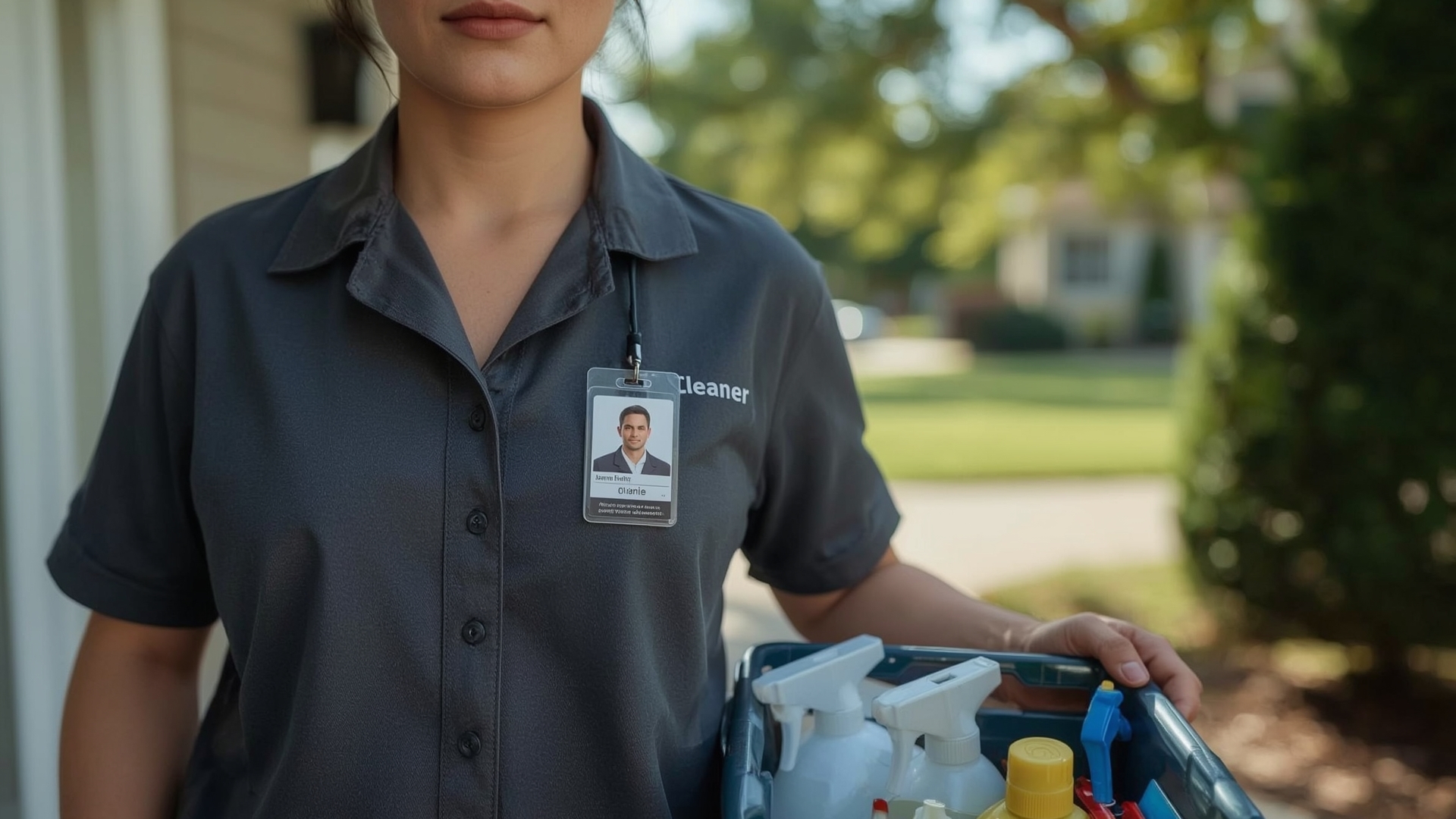
Quick Answer: Background checks work best alongside in-person interviews, skills assessments, uniform or ID badge policies, GPS-tracked service windows, and documented training. These layered vetting steps reduce risk that a background check alone cannot address — like attitude, skill, and accountability.
In-Person or Video Interviews
A formal interview process lets the company assess professionalism, communication, and honesty before a single check runs. Structured interview questions focused on past client scenarios reveal more than a resume.
Training and Certification Requirements
Some cleaning companies require completion of an internal training program before staff work independently. This covers cleaning protocols, product safety, and client interaction standards. Certification through bodies like the International Janitorial Cleaning Services Association (IJCSA) adds a professional credential to the verification stack.
Uniform and Photo ID Badge Policies
Every staff member working in client homes should carry a company-issued photo ID badge. This confirms they’re a verified employee and gives clients a way to identify who is in their space. Uniform requirements also signal professionalism and make it immediately obvious if someone is present who shouldn’t be.
GPS Tracking and Service Windows
Many cleaning companies use GPS-enabled scheduling apps to track when staff arrive and depart client properties. This creates a verifiable service record and provides accountability beyond what any pre-hire check can offer.
How Do Background Check Requirements Differ for Residential vs. Commercial Cleaning?
Quick Answer: Commercial cleaning contracts — especially for government buildings, healthcare facilities, and financial institutions — often require more extensive background checks than residential cleaning. These may include federal-level clearances, drug testing, and sector-specific compliance requirements that exceed standard residential screening.
| Cleaning Sector | Typical Check Level | Additional Requirements | Governing Framework |
|---|---|---|---|
| Residential (standard) | Criminal + identity + sex offender | Reference checks common | FCRA + state laws |
| Residential (luxury/high-value) | Comprehensive multi-layer | NDA may be required | FCRA + state laws |
| Commercial (general office) | Criminal + employment verification | Client facility may set requirements | FCRA + client contract |
| Healthcare facilities | FBI fingerprint-based check | OIG exclusion list check, HIPAA training | CMS, state health department rules |
| Government/defense facilities | Federal security clearance (level varies) | Drug testing, citizenship verification | Federal agency requirements |
| Schools and childcare facilities | Fingerprint-based + state child safety check | State-specific registry checks | State education + child safety laws |
Frequently Asked Questions
Does every cleaning company legally have to run background checks?
No federal law requires cleaning companies to run background checks. However, many state laws, client contracts, and insurance policies effectively require them. Healthcare and government contracts almost always mandate specific screening levels as a condition of the agreement.
Can a cleaning company share my background check results with me?
The background check is run on the employee, not the client. Clients don’t receive copies of employee screening reports. You can ask the company to confirm that a specific worker has been screened and cleared, but the detailed report stays with the employer under FCRA privacy rules.
What is a fingerprint-based background check and when is it required?
A fingerprint-based background check uses biometric data to search FBI criminal databases. It’s more accurate than name-based searches because it doesn’t rely on spelling variations. Fingerprint checks are typically required for cleaning staff in healthcare facilities, schools, and government buildings — not standard residential cleaning.
Do drug tests count as part of the background check process?
Drug testing is a separate process from background screening. Some cleaning companies include it as part of their pre-employment requirements, especially for healthcare or school facility contracts. It’s not standard for most residential cleaning companies, but it’s reasonable to ask whether a company has a drug-free workplace policy.
What happens if a cleaning company sends someone who was not background checked?
If an unscreened worker causes harm or theft, the cleaning company carries significant legal and financial liability. From the client’s side, this is a breach of the service agreement if screening was promised. You’re entitled to ask for proof of screening before any service begins.
Is it a red flag if a cleaning company can’t tell me which background check provider they use?
Yes. A company running credible background checks will know exactly which Consumer Reporting Agency they use and what the package includes. Not knowing — or giving a vague non-answer — suggests screening may be informal, incomplete, or inconsistently applied across staff.
