Green Disinfectants for Home Cleaning: What Actually Works and When to Use Each
Most people assume “green” and “disinfectant” can’t coexist. Either a cleaner is safe for your family and the environment, or it actually kills germs. That’s a false choice. A growing range of EPA-registered green disinfectants use plant-derived and naturally occurring active ingredients that meet the same kill-claim standards as conventional chemical products.
The difference lies in understanding which active ingredient does what, on which surfaces, and against which pathogens. This guide breaks that down with specific data so you can make a confident, informed choice for every room in your home.
Key Takeaways
- EPA registration matters: A disinfectant labeled “green” is only meaningful if it’s on the EPA’s Design for the Environment (DfE) or Safer Choice list — or carries an EPA registration number for kill claims.
- Three active ingredients dominate: Hydrogen peroxide, thymol (from thyme oil), and citric acid are the most widely used and researched green disinfectant actives for home use.
- Contact time determines efficacy: Even effective disinfectants fail if wiped off too soon. Most require 30 seconds to 10 minutes of wet contact time to meet their kill claims.
- Surface compatibility varies: Hydrogen peroxide can bleach fabrics; thymol can leave residue on porous surfaces; citric acid may etch natural stone. Matching the product to the surface protects your home.
- No green disinfectant is universally effective: Different pathogens require different active ingredients. Knowing which pathogen you’re targeting helps you pick the right product.
What Makes a Disinfectant “Green” According to Regulators?
Quick Answer: A green disinfectant meets EPA Safer Choice or Design for the Environment standards, using active ingredients with low mammalian toxicity, biodegradability, and no persistent environmental accumulation — while still carrying a valid EPA registration number for pathogen kill claims.
The term “green” has no universal legal definition on its own. A product can call itself green without any verification. What matters is whether it carries a recognized certification or EPA registration.
The EPA’s Safer Choice program evaluates every ingredient in a product — active and inactive — for human health and environmental safety. The Design for the Environment (DfE) label signals that the formulation meets specific safety and environmental criteria. Neither label is automatic. Manufacturers must submit full ingredient data and pass an EPA review process.
A separate but equally important factor is the EPA registration number. This number confirms the product has been tested and approved to make specific kill claims against named pathogens. Without it, a disinfectant is legally just a cleaner — it may remove dirt but can’t claim to kill viruses or bacteria.
What the EPA Safer Choice Label Actually Confirms
- Active and inactive ingredients reviewed for toxicity, carcinogenicity, and reproductive harm
- Ingredients must biodegrade without forming harmful breakdown products
- No persistent, bioaccumulative, or toxic (PBT) chemicals allowed
- Packaging must be optimized to reduce plastic waste
- Fragrances must be disclosed and evaluated separately
What Are the Main Active Ingredients in Green Disinfectants?
Quick Answer: The three primary active ingredients in EPA-registered green disinfectants are hydrogen peroxide (3–10% concentration), thymol (a natural compound from thyme oil), and citric acid. Each targets different pathogens and works best on different surface types.
Most conventional disinfectants rely on quaternary ammonium compounds (quats) or sodium hypochlorite (bleach). Both are effective, but quats have been linked to respiratory sensitization and aquatic toxicity, and bleach degrades into chlorinated compounds that persist in the environment.
Green disinfectants replace these with naturally derived or naturally occurring actives. The three most common are worth understanding individually.
Hydrogen Peroxide as a Disinfectant Active
Hydrogen peroxide (H₂O₂) works by releasing free oxygen radicals that disrupt the cell walls and proteins of bacteria, fungi, and viruses. It breaks down into water and oxygen, leaving no harmful residue. At concentrations above 3%, it meets EPA kill-claim standards for a broad spectrum of pathogens.
The tradeoff is material compatibility. Hydrogen peroxide can bleach colored fabrics, corrode copper and zinc, and degrade some rubber seals over time. It works best on hard, non-porous, light-colored surfaces.
Thymol as a Disinfectant Active
Thymol is a phenolic compound derived from thyme oil. It disrupts bacterial cell membranes and has demonstrated efficacy against Salmonella, Staph aureus, and influenza A. It’s the active ingredient in several EPA-registered products including the Seventh Generation Disinfecting Spray line.
Thymol has a strong herbal scent that some people find pleasant and others find overpowering. On porous surfaces like unfinished wood, it can leave a slight oily residue. It performs best on smooth, sealed surfaces in kitchens and bathrooms.
Citric Acid as a Disinfectant Active
Citric acid is derived from citrus fermentation. At concentrations of 0.5–5%, it has EPA-registered kill claims against certain bacteria and mold. It excels at dissolving mineral deposits and soap scum, making it especially useful in bathrooms.
Its limitation is that it’s not virucidal (effective against viruses) at typical household concentrations, and it will etch natural stone surfaces like marble, travertine, and unsealed granite. It should not be used on these materials.
How Do Green Disinfectants Compare to Conventional Products in Efficacy?
Quick Answer: EPA-registered green disinfectants match conventional products for most common household pathogens when used correctly. The key difference is contact time — green actives often require longer dwell time (1–10 minutes) compared to quats or bleach (30 seconds to 2 minutes).
Efficacy comes down to three variables: active ingredient concentration, contact time (how long the surface stays wet), and the pathogen being targeted. Green actives are genuinely effective — the gap is usually in how people use them, not in the chemistry itself.
Most users spray and wipe immediately. That doesn’t give any disinfectant — green or conventional — enough time to work. Reading the label contact time is non-negotiable.
Green Disinfectant Efficacy Comparison Table
| Active Ingredient | Concentration Range | Contact Time Required | Bacteria | Viruses (Enveloped) | Mold/Fungi |
|---|---|---|---|---|---|
| Hydrogen Peroxide | 3–10% | 1–5 minutes | Broad spectrum | Effective | Effective |
| Thymol | 0.05–0.1% | 30 seconds–2 minutes | Broad spectrum | Effective (influenza) | Limited |
| Citric Acid | 0.5–5% | 5–10 minutes | Limited spectrum | Not effective at household concentrations | Moderate |
| Sodium Hypochlorite (bleach, for comparison) | 0.5–6% | 30 seconds–1 minute | Broad spectrum | Highly effective | Highly effective |
Which Green Disinfectant Works Best on Each Surface?
Quick Answer: Hydrogen peroxide suits hard non-porous surfaces like stainless steel and sealed tile. Thymol is best for kitchen counters and bathroom fixtures. Citric acid excels on bathroom grout, shower glass, and faucets — but must never be used on natural stone.
Matching the right product to the right surface prevents two problems: surface damage and wasted efficacy. A disinfectant that bonds poorly with a surface or gets absorbed into it can’t maintain the wet contact time needed to kill pathogens.
Surface Compatibility EAV Table
| Surface Type | Best Active Ingredient | Avoid | Notes |
|---|---|---|---|
| Stainless Steel (sinks, appliances) | Hydrogen Peroxide (3%) | Citric Acid (can pit over time) | Wipe in direction of grain; avoid prolonged contact |
| Sealed Ceramic Tile | Hydrogen Peroxide or Thymol | None of the three have issues | Check grout seal before using citric acid near grout lines |
| Laminate Countertops | Thymol or Hydrogen Peroxide | High-concentration citric acid | Prolonged citric acid exposure can dull the finish |
| Natural Stone (marble, granite) | Thymol only | Citric Acid, Hydrogen Peroxide (etching risk) | Use pH-neutral formulations; always test on hidden area |
| Glass (shower screens, mirrors) | Citric Acid or Hydrogen Peroxide | None | Citric acid dissolves mineral deposits; hydrogen peroxide removes biofilm |
| Plastic (toilet seats, light switches) | Thymol or Hydrogen Peroxide | High-concentration H₂O₂ (may yellow) | Keep concentration at 3% or below for white plastics |
| Fabric/Upholstery | Thymol (diluted) | Hydrogen Peroxide (bleaching risk) | Always spot-test first; let dry fully before contact |
| Unfinished/Porous Wood | None recommended | All three | Moisture damages wood; use a wood-safe antimicrobial or seal first |
Which Pathogens Do Green Disinfectants Actually Kill?
Quick Answer: Hydrogen peroxide kills bacteria, fungi, and most enveloped viruses. Thymol is effective against bacteria and influenza A. Citric acid handles bacteria and mold at higher concentrations. None of the three are registered for non-enveloped viruses like norovirus at typical home-use concentrations.
Pathogens fall into categories that respond very differently to disinfectant chemistry. Enveloped viruses (like influenza and coronaviruses) have a fatty outer layer that is easily disrupted by most active ingredients. Non-enveloped viruses (like norovirus) are much harder to inactivate and require more aggressive chemistry or longer contact times.
Bacteria with biofilm protection (a thin protective layer they secrete on surfaces) are also harder to kill. This is common in kitchen drains and bathroom grout. Physically scrubbing the surface before applying a disinfectant breaks down the biofilm and dramatically improves kill rates.
Pathogen-Specific Efficacy EAV Table
| Pathogen Type | Example Organisms | Best Green Active | Minimum Contact Time | Efficacy Level |
|---|---|---|---|---|
| Gram-positive bacteria | Staph aureus, Streptococcus | Thymol or H₂O₂ | 30 seconds–1 minute | High (>99.9%) |
| Gram-negative bacteria | E. coli, Salmonella | H₂O₂ or Thymol | 1–2 minutes | High (>99.9%) |
| Enveloped viruses | Influenza A, SARS-CoV-2 | Thymol or H₂O₂ | 30 seconds–2 minutes | High (>99.99%) |
| Non-enveloped viruses | Norovirus, Rhinovirus | None reliably at home concentrations | N/A | Low–Moderate |
| Mold and fungi | Aspergillus, Cladosporium | H₂O₂ (5–10%) | 5–10 minutes | Moderate–High |
| Bacterial biofilm | Pseudomonas, Legionella | H₂O₂ (combined with scrubbing) | 10 minutes post-scrub | Moderate (scrubbing required first) |
How Should You Use Green Disinfectants Room by Room?
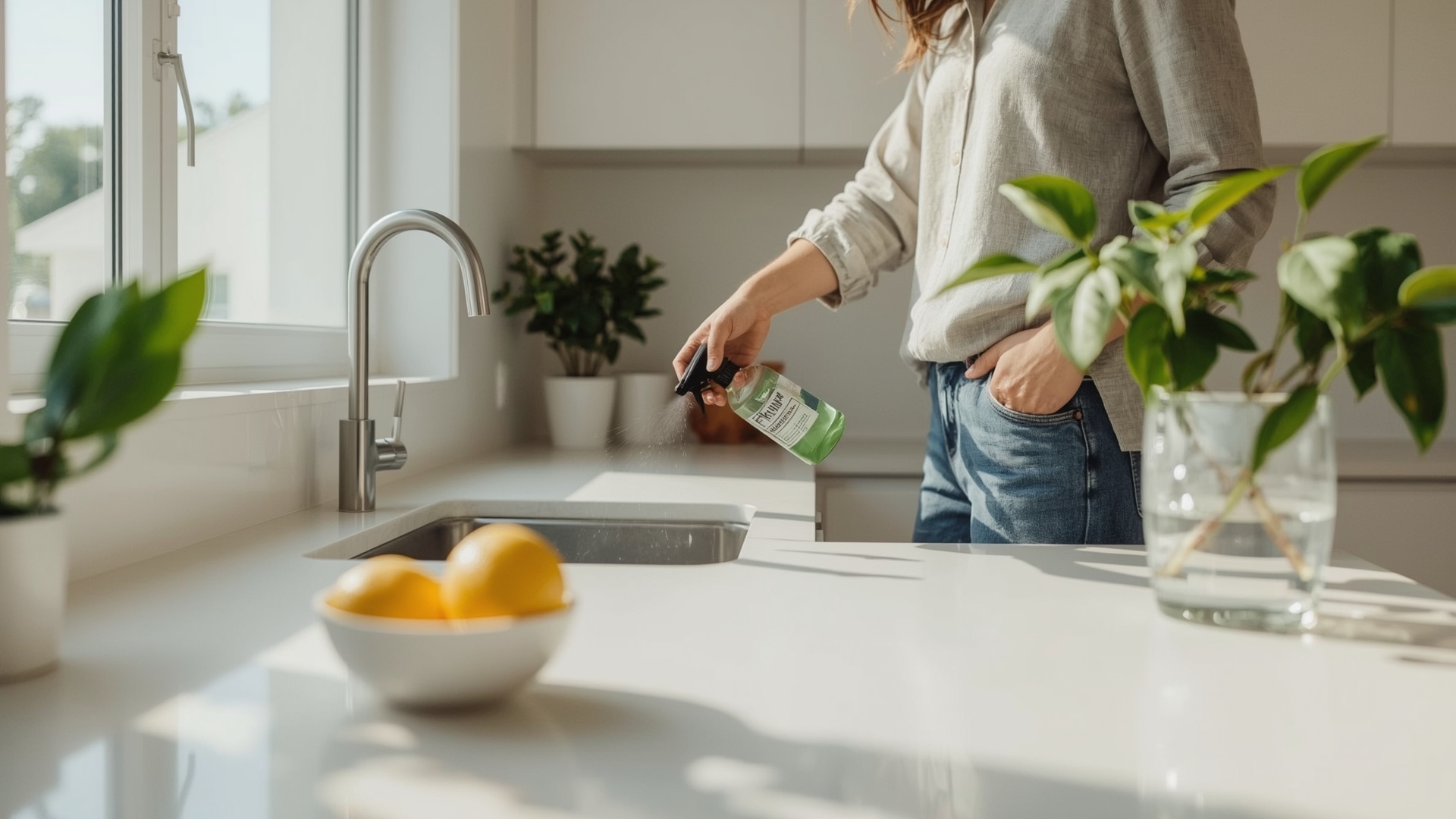
Quick Answer: In kitchens, use thymol or hydrogen peroxide on counters and appliances after food prep. In bathrooms, citric acid handles mineral buildup on fixtures while hydrogen peroxide tackles mold on grout. In high-touch areas like door handles and light switches, thymol is fast and effective.
Different rooms have different pathogen risks, surface types, and cleaning frequencies. A one-product approach is rarely optimal. Rotating between active ingredients based on the room’s primary risk is more effective than picking one product for the whole house.
Kitchen Disinfection
The kitchen’s main risks are foodborne bacteria: E. coli, Salmonella, Listeria, and Campylobacter. These live on cutting boards, sink basins, faucet handles, and countertop surfaces that come into contact with raw meat or unwashed produce.
Thymol-based sprays work well here because they’re effective against these bacteria within 30 seconds to 2 minutes and don’t require rinsing on food-contact surfaces at labeled dilutions. Hydrogen peroxide at 3% is a strong backup — it’s residue-free and handles a broader spectrum of organisms, but needs 1 to 5 minutes of wet contact time.
Bathroom Disinfection
Bathrooms combine mold risk (humidity), skin bacteria (toilet and sink areas), and mineral deposit buildup on fixtures. This makes the bathroom the one room where rotating between actives adds the most value.
Use citric acid-based products for weekly fixture cleaning — it removes soap scum and mineral deposits while providing antibacterial action. Use hydrogen peroxide at 5–10% for mold on grout and silicone seals, applying it and letting it sit for 5 to 10 minutes before rinsing. Thymol works well on toilet seats and door handles where you want a fast contact time.
High-Touch Surface Disinfection
Light switches, door handles, cabinet pulls, TV remotes, and phone charging areas accumulate skin bacteria and enveloped viruses from contact. Thymol-based sprays or pre-moistened wipes are ideal here — they work in under 2 minutes and leave no film that requires rinsing.
Room-by-Room Disinfection Protocol EAV Table
| Room/Area | Primary Pathogen Risk | Recommended Active | Application Method | Frequency |
|---|---|---|---|---|
| Kitchen counters | Salmonella, E. coli, Listeria | Thymol or H₂O₂ 3% | Spray and let sit 1–2 min | After each food prep session |
| Kitchen sink and drain | Biofilm bacteria, mold | H₂O₂ 3–5% + scrubbing | Spray, scrub, sit 5 min, rinse | 2–3x per week |
| Bathroom toilet | E. coli, Staph aureus | Thymol or H₂O₂ | Spray, sit 1–2 min, wipe | Weekly minimum |
| Shower grout and silicone | Mold, mildew | H₂O₂ 5–10% | Apply, sit 10 min, scrub, rinse | Monthly or at first sign of growth |
| Bathroom fixtures and glass | Mineral deposits, bacteria | Citric Acid 1–5% | Spray, sit 5–10 min, wipe | Weekly |
| Door handles and light switches | Skin bacteria, enveloped viruses | Thymol | Spray or wipe, sit 30 sec–1 min | 2–3x per week or during illness |
Are Green Disinfectants Safe Around Children and Pets?
Quick Answer: Green disinfectants are generally lower-risk than conventional products, but they’re not hazard-free. Hydrogen peroxide above 3% is an irritant. Thymol can trigger reactions in people with plant allergies. Citric acid can irritate airways. Let all surfaces dry fully before children or pets re-enter the area.
Lower toxicity doesn’t mean zero toxicity. The safety advantage of green disinfectants is that their breakdown products are benign and they don’t accumulate in the environment or in body tissue. But during and immediately after application, they still require common-sense precautions.
Safety Precautions by Active Ingredient
- Hydrogen Peroxide: Wear gloves at concentrations above 3%. Keep away from eyes. Ventilate the room. Don’t mix with vinegar — the combination creates peracetic acid, which is more corrosive than either alone.
- Thymol: Avoid direct skin contact with concentrated formulations. People with allergies to Lamiaceae plants (mint, basil, oregano) may react. Keep pets off treated surfaces until fully dry.
- Citric Acid: Can irritate airways when sprayed in an enclosed space. Open windows or use in ventilated areas. Safe once dry. Cats are sensitive to citrus compounds — ensure full evaporation before allowing access.
How Do You Read an EPA Registration Number on a Green Disinfectant?
Quick Answer: An EPA registration number has the format XX-XXXX (e.g., 87583-2). The first set of digits identifies the company, the second identifies the specific product. You can verify it on the EPA’s online pesticide product search database to confirm labeled kill claims.
Every disinfectant sold in the US must be registered with the EPA to make kill claims. The registration number is usually printed on the back label near the active ingredients. It’s not a certification of green status — it’s a confirmation that the product’s efficacy claims have been tested and reviewed.
The EPA also maintains a List N of products effective against SARS-CoV-2. If a green disinfectant appears on List N, its active ingredient has demonstrated efficacy against coronaviruses under EPA-reviewed test conditions. Several hydrogen peroxide and thymol products appear on this list.
What Are the Best EPA-Registered Green Disinfectant Products for Home Use?
Quick Answer: Seventh Generation Disinfecting Spray (thymol, EPA Reg. No. 87583-2), Better Life Household Cleaner (thymol-based), and Benefect Botanical Disinfectant (thymol, 99.9% kill claim) are well-established EPA-registered options. Hydrogen peroxide-based options include Ecolab Oxivir and H2Orange2 (commercial grade).
When evaluating any product, look for three things: an EPA registration number, the Safer Choice or DfE label, and a specific kill claims list on the label (naming pathogens and contact times). Any product missing all three of these elements is a cleaner, not a disinfectant — regardless of its green marketing.
EPA-Registered Green Disinfectant Products EAV Table
| Product Name | Active Ingredient | EPA Reg. No. | Safer Choice / DfE | Kill Claim (Contact Time) | Best Use |
|---|---|---|---|---|---|
| Seventh Generation Disinfecting Spray | Thymol 0.05% | 87583-2 | EPA DfE listed | 99.9% bacteria (2 min) | Kitchens, bathrooms, high-touch surfaces |
| Benefect Botanical Disinfectant | Thymol 0.05% | 74771-1 | Safer Choice listed | 99.9% bacteria, influenza A (30 sec) | All hard surfaces, post-flood remediation |
| Ecolab Oxivir Tb | Hydrogen Peroxide 0.5% | 1677-238 | DfE certified | 99.999% bacteria, MRSA (1 min) | Hard non-porous surfaces, healthcare-grade |
| Force of Nature | Hypochlorous Acid (electrolyzed) | 87849-1 | Safer Choice listed | 99.9% bacteria, List N EPA (2 min) | General home surfaces, safe around kids/pets |
| Nature’s Miracle Disinfectant Spray | Citric Acid 0.5% | Multiple depending on SKU | Not Safer Choice listed | 99.9% bacteria (5–10 min) | Bathrooms, hard fixtures |
Can You Make an Effective Green Disinfectant at Home?
Quick Answer: No. Homemade mixtures of vinegar, essential oils, or baking soda have not been EPA-tested for disinfection. They may clean, but they cannot legally or reliably claim to kill specific pathogens at measurable rates. For true disinfection, use an EPA-registered product.
This is one of the most common points of confusion in the green cleaning space. Vinegar (acetic acid) can inhibit some bacteria in high concentrations, but it’s not registered as a disinfectant. Essential oils like tea tree and eucalyptus show antimicrobial activity in lab settings, but home-diluted mixtures have no verified kill claims against specific pathogens at specific contact times.
If you’re using a homemade spray to freshen surfaces or remove dirt, that’s a valid use. But if you’re trying to disinfect a surface after raw chicken contact or during a household illness, a registered product is the only way to verify you’re getting the protection you think you are.
How Do You Store and Dispose of Green Disinfectants Safely?
Quick Answer: Store green disinfectants in a cool, dark location away from direct sunlight. Hydrogen peroxide degrades faster in light and heat. Most green disinfectants can be disposed of by diluting and flushing down the drain. Always check the label for product-specific instructions.
Green active ingredients are generally less hazardous to dispose of than conventional disinfectants. Hydrogen peroxide breaks down to water and oxygen. Thymol and citric acid biodegrade readily in wastewater systems. However, some formulations include preservatives or surfactants that need label-specific disposal guidance.
Hydrogen peroxide must be stored away from light. Amber or opaque bottles significantly extend its effective shelf life. Once opened, standard 3% hydrogen peroxide typically loses potency within 30–45 days.
Frequently Asked Questions
Is hydrogen peroxide strong enough to kill mold on bathroom grout?
Yes, but you need a 5–10% concentration and a contact time of at least 10 minutes. Standard 3% drugstore hydrogen peroxide is less effective on established mold colonies. For better results, scrub the grout to break up biofilm first, then apply and let it sit before rinsing.
Can I use a thymol disinfectant on a food prep surface?
Yes, provided the product label permits food-contact surface use. Benefect and Seventh Generation’s thymol-based sprays are formulated for use on food-contact surfaces without rinsing at the labeled dilution. Always check the specific product label before using any disinfectant where food will be placed.
What is hypochlorous acid and is it considered a green disinfectant?
Hypochlorous acid is a mild acid produced by electrolysis of salt and water. It’s what your immune system naturally produces to fight infection. Products like Force of Nature use it as an active ingredient. It’s considered green because it breaks down to saltwater, has low toxicity, and is on the EPA Safer Choice list.
Do green disinfectants work against COVID-19?
Several do. The EPA’s List N includes green-certified products with thymol and hydrogen peroxide active ingredients proven effective against SARS-CoV-2. Always verify a specific product appears on List N rather than assuming any green label provides coronavirus protection.
Why does my green disinfectant smell like herbs?
Thymol-based disinfectants have a distinct herbal scent because thymol comes from thyme oil. The smell comes from the active ingredient itself, not added fragrance. It dissipates within 15–30 minutes in a ventilated room. Some formulations add complementary plant-based scents to soften it.
Can citric acid disinfectants replace bathroom limescale removers?
Yes, with one important condition. Citric acid dissolves calcium carbonate deposits — the mineral compound in limescale — while also providing antibacterial action. It effectively replaces separate limescale and disinfectant products for bathroom fixtures. Never use it on natural stone surfaces, as it will etch and dull the finish permanently.