Commercial Floor Scrubber Types and Uses: The Complete Guide
Picking the wrong floor scrubber wastes time, damages surfaces, and leaves floors looking worse than before. But with walk-behind machines, ride-on units, cylindrical brushes, and orbital systems all competing for your attention, choosing the right one isn’t obvious.
This guide breaks down every major commercial floor scrubber type, explains what each machine does best, and shows you how to match pad selection and RPM to the floor surface in front of you.
Key Takeaways
- Walk-behind scrubbers are best for small-to-medium spaces under 10,000 sq ft where maneuverability matters.
- Ride-on scrubbers cover large open areas quickly, typically 30,000 to 80,000 sq ft per hour.
- Cylindrical brush machines clean grout lines and uneven surfaces that flat disc pads miss.
- Orbital scrubbers use low RPM (175 RPM or less) and are the safest option for sensitive surfaces like hardwood or luxury vinyl tile (LVT).
- Pad selection (color and abrasiveness) matters as much as machine type — the wrong pad can strip coatings or leave surfaces unclean.
- RPM range determines agitation intensity. Higher RPM removes tough buildup; lower RPM preserves delicate finishes.
What Is a Commercial Floor Scrubber and How Does It Work?
Quick Answer: A commercial floor scrubber is a powered cleaning machine that applies water and detergent to a floor, scrubs with a rotating brush or pad, then vacuums the dirty water back up in one pass. It replaces mops and reduces labor time significantly.
A floor scrubber has three main systems working together. The solution tank releases a measured amount of water and detergent onto the floor ahead of the scrubbing head. The scrubbing head — fitted with a pad or brush — agitates the surface to loosen dirt and grime. The recovery tank then suctions the dirty water back up, leaving the floor nearly dry.
This one-pass process is what separates scrubbers from mops. A mop spreads dirty water around. A scrubber removes it. That difference matters in commercial settings where floor safety and appearance are tied directly to business operations.
How Scrubbers Differ From Burnishers and Sweepers
Scrubbers clean. Burnishers polish. Sweepers collect dry debris. A burnisher runs at 1,000 to 3,000 RPM and creates a high-gloss shine on coated floors, but it doesn’t clean. A sweeper picks up dust, sand, and loose debris before scrubbing. Many facilities use all three machines in sequence for best results.
What Are the Main Types of Commercial Floor Scrubbers?
Quick Answer: The four main types are walk-behind scrubbers, ride-on scrubbers, cylindrical brush scrubbers, and orbital scrubbers. Each suits different floor sizes, surface types, and soil levels. Choosing the wrong type reduces cleaning effectiveness and can damage floors.
Walk-Behind Scrubbers
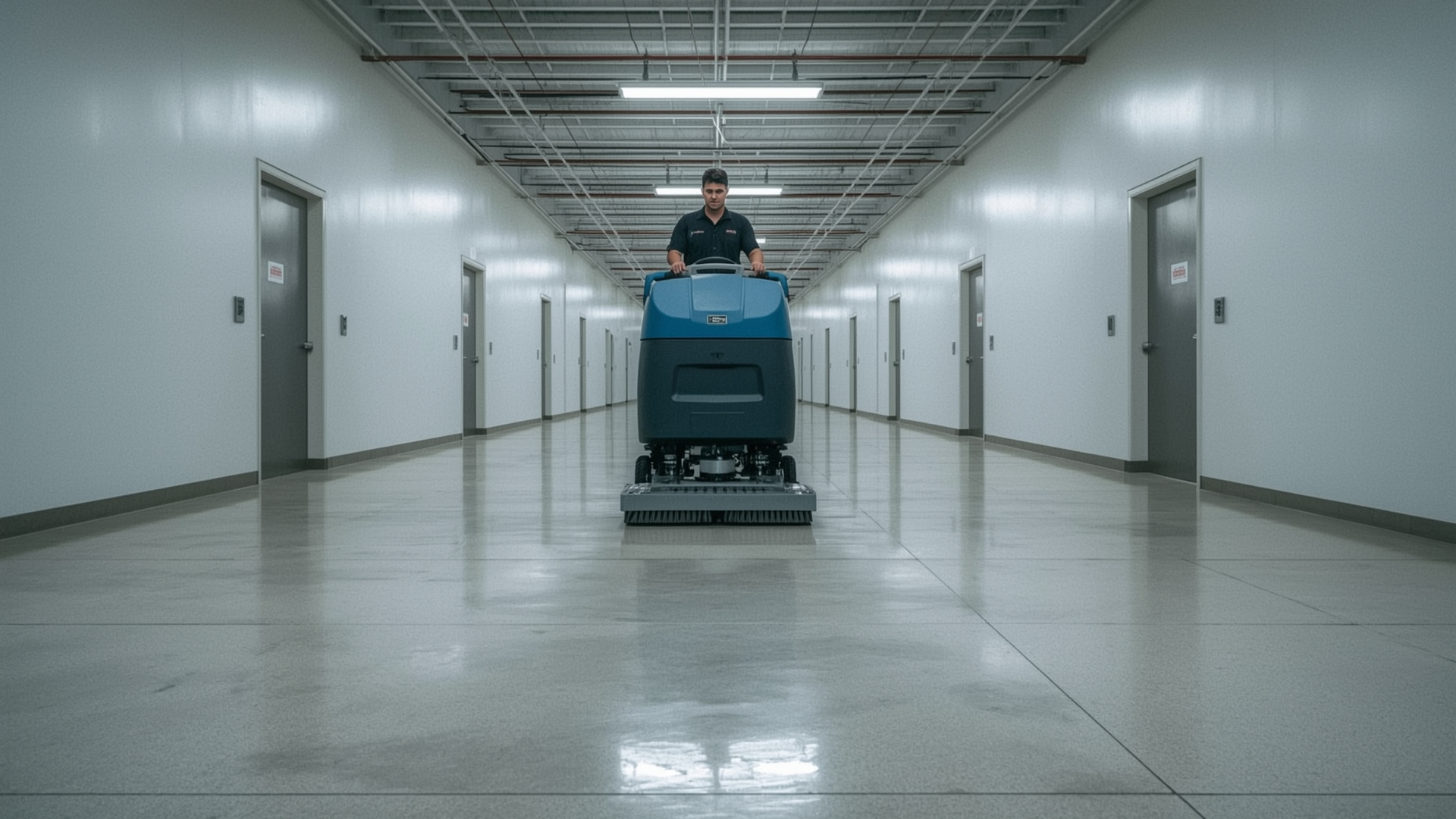
Walk-behind scrubbers are the most common machine in commercial cleaning. An operator walks behind the machine, guiding it across the floor. They typically cover 5,000 to 25,000 sq ft per hour, depending on model size and path width.
These machines suit retail stores, school hallways, healthcare corridors, and restaurant kitchens. Their smaller footprint lets them navigate around shelving, furniture, and tight corners where a ride-on unit can’t fit.
Walk-behind scrubbers come in two sub-types: compact (micro) scrubbers with a 13-to-17-inch cleaning path for very tight spaces, and mid-size walk-behind scrubbers with an 18-to-28-inch path for open corridors and standard-size rooms.
Ride-On Scrubbers
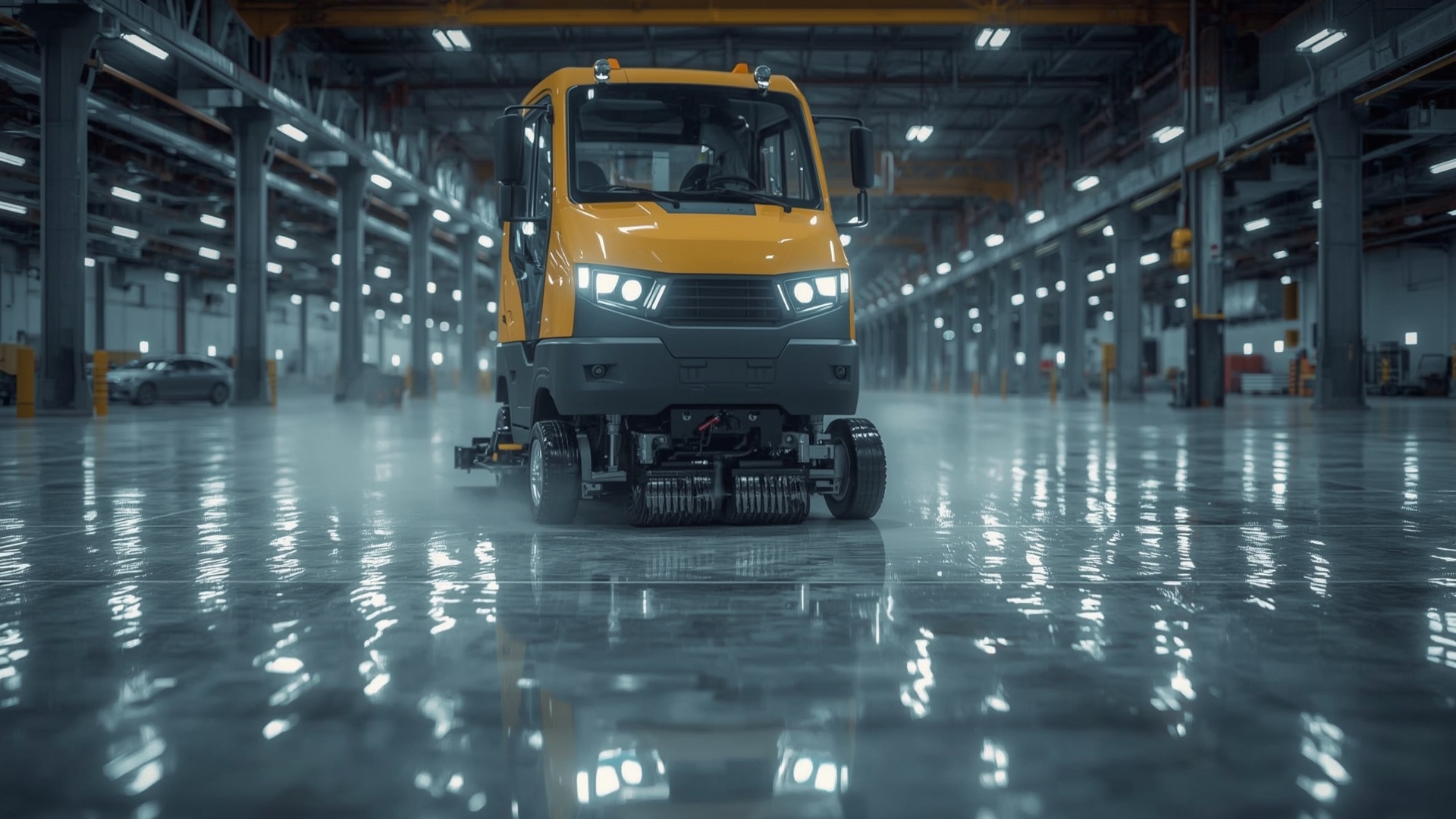
Ride-on scrubbers are designed for large open floor areas. An operator sits on the machine, which covers 30,000 to 80,000 sq ft per hour. They’re used in warehouses, airport terminals, large retail stores, convention centers, and manufacturing plants.
These machines have wider cleaning paths (28 to 36 inches or more), larger solution and recovery tanks, and longer run times on a single charge. They reduce operator fatigue significantly compared to walking equivalent distances.
The tradeoff is maneuverability. Ride-on units struggle in narrow aisles, around tight obstacles, or in spaces with frequent layout changes.
Cylindrical Brush Scrubbers
Cylindrical brush scrubbers use rotating cylindrical brushes instead of flat disc pads. The brushes make contact with the floor on a horizontal axis, sweeping forward and scrubbing simultaneously. This design works exceptionally well on uneven surfaces, textured tiles, quarry tile, and floors with grout lines.
Flat disc pads skim over grout lines. Cylindrical brushes reach into them. For commercial kitchens, outdoor areas, loading docks, and food processing facilities with textured safety flooring, cylindrical brush machines outperform disc pad systems on soil removal.
Many cylindrical models also sweep and scrub in one pass, which eliminates the need for a separate sweeper run first.
Orbital (Random Orbital) Scrubbers
Orbital scrubbers use an elliptical scrubbing motion instead of rotary spinning. The pad moves in a small, randomized circular pattern at low speeds, typically under 175 RPM. This low-agitation approach generates minimal friction heat, which makes it safe for surfaces that can’t handle high RPM.
Orbital scrubbers are commonly used on hardwood floors, luxury vinyl tile (LVT), vinyl composition tile (VCT) without floor finish, rubber flooring, and natural stone. They can also strip floor finish from VCT using a chemical stripping pad without the heat damage a high-speed disc machine might cause.
How Do Disc Pad Scrubbers Compare to Cylindrical Brush Scrubbers?
Quick Answer: Disc pad scrubbers work best on smooth, level floors like polished concrete, VCT, and linoleum. Cylindrical brush scrubbers outperform them on uneven or textured surfaces because the brushes reach into grout lines and surface gaps that flat pads skip over.
| Attribute | Disc Pad Scrubber | Cylindrical Brush Scrubber |
|---|---|---|
| Best Surface Type | Smooth, flat floors | Textured, uneven floors |
| Grout Line Cleaning | Poor | Excellent |
| Sweeping Capability | No (requires pre-sweep) | Yes (sweep + scrub in one pass) |
| Typical RPM Range | 175–400 RPM | Not RPM-based (brush speed varies) |
| Maintenance Complexity | Low (pad swap takes under 1 min) | Higher (brush replacement, alignment) |
| Common Settings | Retail, healthcare, education | Kitchens, loading docks, food facilities |
What Scrubber Pad Colors Mean and Which Pad Should You Use?

Quick Answer: Scrubber pads use a color-coding system from white (gentle polishing) to black (aggressive stripping). Matching pad color to your cleaning task prevents surface damage. Using a black stripping pad for daily maintenance will wear through floor coatings prematurely.
The pad color system is an industry-wide standard. Most major pad manufacturers, including 3M and Diversey, follow the same color hierarchy. Here’s how to read it:
| Pad Color | Abrasiveness Level | Primary Use | Recommended RPM | Suitable Floors |
|---|---|---|---|---|
| White | Very Low | Final polish / light buffing | 175–350 RPM | VCT, polished concrete |
| Beige / Tan | Low | Light scrubbing, daily maintenance | 175–350 RPM | VCT, linoleum, LVT |
| Red | Moderate | Light to medium scrubbing, spray buffing | 175–400 RPM | VCT, sealed concrete, terrazzo |
| Blue | Moderate-High | Scrubbing soiled floors | 175–300 RPM | VCT, linoleum, rubber |
| Green | High | Heavy scrubbing, prep work | 175–250 RPM | Concrete, quarry tile |
| Black | Very High | Stripping floor finish | 175–250 RPM | VCT, concrete (stripping only) |
One important rule: pad abrasiveness and machine RPM multiply each other’s effect. A green pad at 400 RPM on a sensitive floor can cause permanent surface damage. When in doubt, test any new pad-and-RPM combination in a hidden corner first.
What RPM Range Does Each Floor Scrubber Type Use?
Quick Answer: Standard disc scrubbers run at 175 to 400 RPM for daily cleaning. High-speed burnishers run at 1,000 to 3,000 RPM for polishing. Orbital scrubbers operate under 175 RPM. Matching RPM to surface hardness prevents coating damage and floor degradation.
| Machine Type | RPM Range | Primary Purpose | Pad/Brush Type |
|---|---|---|---|
| Orbital Scrubber | Under 175 RPM | Delicate surface cleaning, finish stripping | Various pads |
| Standard Walk-Behind Scrubber | 175–250 RPM | Daily maintenance, moderate soil removal | Beige, red, blue pads |
| Heavy-Duty Walk-Behind Scrubber | 250–400 RPM | Heavy soil removal, prep work | Blue, green pads |
| Ride-On Scrubber | 175–350 RPM | Large area maintenance and cleaning | Red, blue, green pads |
| Low-Speed Burnisher | 1,000–1,500 RPM | Restoring shine on coated floors | Burnishing pad |
| High-Speed Burnisher | 1,500–3,000 RPM | High-gloss finish on VCT and concrete | Ultra-high speed pad |
Which Floor Scrubber Works Best on Each Surface Type?
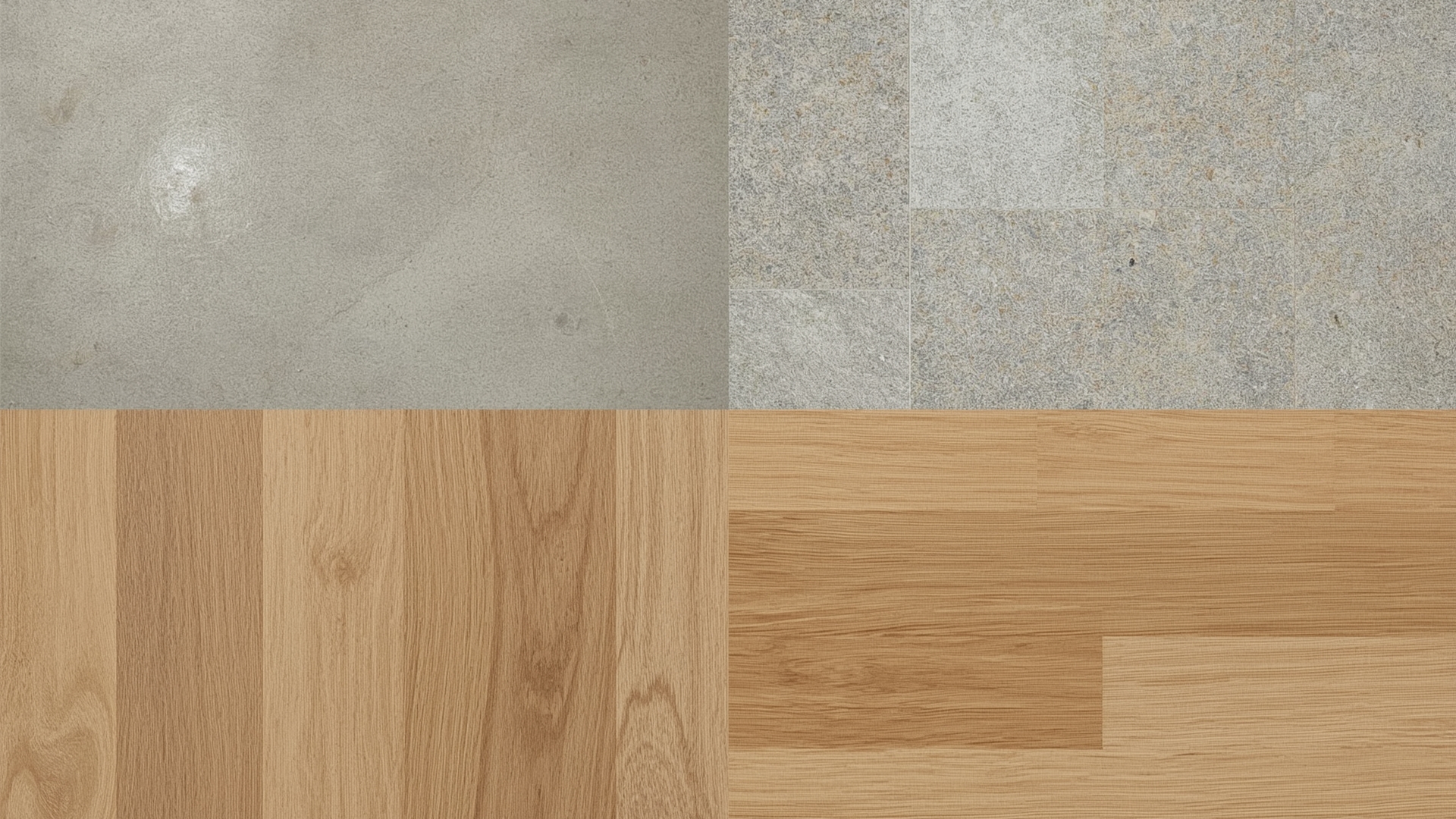
Quick Answer: Polished concrete and VCT work best with standard disc scrubbers at 175 to 300 RPM. Hardwood and LVT need orbital scrubbers under 175 RPM. Quarry tile and grout-line floors need cylindrical brush machines. Natural stone needs low RPM with a pH-neutral detergent.
Vinyl Composition Tile (VCT)
VCT is the most common commercial floor type. It’s a durable tile made from vinyl and limestone composite. Standard disc scrubbers with red or blue pads at 175 to 300 RPM handle daily maintenance well. For stripping old floor finish, switch to a black pad at 175 to 250 RPM with a chemical floor stripper solution.
Polished Concrete
Polished concrete is hard and dense. It can handle higher RPM but doesn’t need aggressive pads for routine maintenance. A walk-behind or ride-on disc scrubber with a red or blue pad at 200 to 350 RPM removes dirt without dulling the surface. For deep cleaning, a green pad at lower RPM works well. Never use black stripping pads on polished concrete — they’ll scratch the surface.
Luxury Vinyl Tile (LVT) and Luxury Vinyl Plank (LVP)
LVT and LVP have a wear layer that high RPM machines can soften or scratch. An orbital scrubber under 175 RPM with a white or tan pad is the right choice. Never use high-speed machines or abrasive pads on LVT — the wear layer is typically only 12 to 28 mils thick and doesn’t recover from abrasion damage.
Hardwood and Engineered Wood
Hardwood floors in gyms, event spaces, and retail environments need the most careful approach. Use an orbital scrubber with a microfiber or white pad. Keep water output extremely low — excess moisture warps and stains wood. Avoid rotary disc machines on any unfinished or soft-finish wood entirely.
Quarry Tile and Ceramic Tile with Grout
These surfaces have texture and grout lines. A cylindrical brush scrubber is the right tool. The brush reaches into grout lines and removes embedded dirt that flat pads miss. Use a pH-neutral or alkaline cleaner depending on the soil type. Acidic cleaners will damage grout over time.
Rubber Flooring
Rubber flooring is common in gyms, locker rooms, and healthcare facilities. It needs low RPM and a non-abrasive pad (white or tan). An orbital scrubber or a low-RPM walk-behind machine works well. High RPM and harsh chemicals can dry out rubber, causing cracking and surface degradation.
Natural Stone (Marble, Granite, Terrazzo)
Natural stone is sensitive to both chemical pH and abrasion. Use a walk-behind scrubber at 175 to 250 RPM with a soft red or white pad. Always use a pH-neutral cleaner — acidic detergents etch stone surfaces permanently. Terrazzo specifically benefits from orbital scrubbers that minimize micro-scratching across the stone aggregate.
What Size Scrubber Do You Need for Your Facility?
Quick Answer: Facilities under 5,000 sq ft suit compact walk-behind scrubbers with a 13-to-17-inch path. Spaces from 5,000 to 30,000 sq ft work well with mid-size walk-behind models. Anything above 30,000 sq ft benefits from a ride-on scrubber to keep cleaning time practical.
| Facility Size | Recommended Scrubber Type | Cleaning Path Width | Estimated Coverage Rate | Typical Settings |
|---|---|---|---|---|
| Under 5,000 sq ft | Compact walk-behind | 13–17 inches | 5,000–10,000 sq ft/hr | Restaurants, small retail, clinics |
| 5,000–15,000 sq ft | Mid-size walk-behind | 18–24 inches | 10,000–20,000 sq ft/hr | Schools, supermarkets, offices |
| 15,000–30,000 sq ft | Large walk-behind | 24–28 inches | 15,000–25,000 sq ft/hr | Large retail, hospitals, arenas |
| 30,000–80,000 sq ft | Ride-on scrubber | 28–36 inches | 30,000–80,000 sq ft/hr | Warehouses, airports, distribution centers |
| 80,000+ sq ft | Large ride-on or autonomous scrubber | 36+ inches | 60,000–120,000 sq ft/hr | Airports, stadiums, large manufacturing plants |
What Power Source Should a Commercial Floor Scrubber Use?
Quick Answer: Battery-powered scrubbers are the most common choice for indoor use because they produce no fumes. Propane machines suit large outdoor or well-ventilated facilities. Corded electric models work for small spaces with good outlet access. Lithium-ion batteries now offer 4 to 8 hours of run time per charge.
Battery (Lead-Acid vs. Lithium-Ion)
Most commercial scrubbers run on rechargeable batteries. Traditional lead-acid batteries last 2 to 4 hours per charge and require 8 to 10 hours to recharge. Lithium-ion (Li-ion) batteries last 4 to 8 hours, recharge in 2 to 4 hours, and hold their charge better over hundreds of cycles. Li-ion machines cost more upfront but reduce downtime significantly in high-use environments.
Propane-Powered Scrubbers
Propane machines are used in large, well-ventilated spaces like outdoor parking structures, loading bays, and aircraft hangars. They run continuously without battery limits but produce exhaust, so they’re unsuitable for indoor use without serious ventilation. They also require propane tank management as part of your operations.
Corded Electric
Corded machines are the most affordable option. They suit small spaces where moving around a power cord is manageable. They’re common in cleaning closets, short hallways, and single-room applications. Coverage is limited by cord length, typically 50 to 100 feet.
What Detergents and Solutions Work With Floor Scrubbers?
Quick Answer: Use low-foaming, pH-balanced detergents formulated for auto-scrubbers. High-foam detergents clog the recovery tank and reduce suction. For daily cleaning, a neutral pH detergent (pH 7) works on most surfaces. Alkaline cleaners (pH 8–11) handle grease. Acidic cleaners (pH below 7) remove mineral deposits but damage stone and grout.
Matching pH to Soil Type and Surface
Detergent pH determines what it can break down. Grease and oils respond to alkaline cleaners. Mineral deposits and hard water scale respond to acidic cleaners. Most daily floor maintenance uses neutral pH solutions that are gentle on coatings and safe for most surfaces.
Using the wrong pH cleaner won’t just clean poorly — it can permanently damage floors. Acidic cleaners etch marble and limestone. High-alkaline cleaners strip floor finish faster than intended. Always check the floor manufacturer’s care guidelines before selecting a detergent.
Dilution Ratios and Solution Tank Management
Over-concentration doesn’t clean better — it leaves residue. Most auto-scrubber detergents are concentrated and need dilution ratios between 1:32 and 1:128 (product to water). Always follow label ratios. Residue from undiluted or high-foam detergents attracts more dirt and makes floors look worse after cleaning.
How Do You Maintain a Commercial Floor Scrubber?
Quick Answer: After every use, empty and rinse both the solution and recovery tanks, clean the squeegee blade, and inspect pads or brushes for wear. Weekly tasks include checking brush pressure, testing battery health, and clearing debris from the suction path. Neglecting recovery tank cleaning causes odors and bacterial growth.
Daily Maintenance Tasks
- Empty and rinse the recovery (dirty water) tank completely
- Rinse the solution tank if residue is present
- Remove and inspect the scrubbing pad or brush — replace if worn or embedded with debris
- Clean the squeegee blade with a damp cloth; check for nicks or deformation
- Charge the battery fully after each shift (lead-acid: don’t partial-charge repeatedly)
Weekly and Monthly Maintenance Tasks
- Check and adjust brush or pad pressure settings
- Inspect the suction hose and filter for clogs
- Test squeegee blade alignment — an off-center blade leaves water streaks
- Clean the vacuum motor filter (monthly or as needed)
- Inspect battery terminals for corrosion (lead-acid batteries)
- Review the machine manual for manufacturer-specific service intervals
When Should You Use an Autonomous Floor Scrubber?
Quick Answer: Autonomous scrubbers make sense in facilities over 50,000 sq ft with predictable, open floor layouts. They operate during off-hours without supervision, reducing labor costs. They’re not suitable for cluttered environments, complex layouts, or areas with frequent obstacles. Upfront cost ranges from $15,000 to $80,000.
Autonomous (robotic) floor scrubbers use sensors, mapping technology, and pre-programmed routes to clean without an operator. They’ve become practical in airports, large retail chains, and hospitals over the last several years.
They’re not a replacement for all scrubbing needs. They can’t clean near walls or in corners as precisely as a human operator, and they don’t adapt well to sudden obstacles or layout changes. Most facilities use them for routine open-area maintenance and rely on traditional machines for edge cleaning and problem areas.
Frequently Asked Questions
What is the difference between a floor scrubber and a floor polisher?
A floor scrubber cleans by applying water and detergent, then recovering the dirty solution. A floor polisher (burnisher) spins at high RPM (1,000 to 3,000) to create shine on coated floors without adding water. Polishers don’t clean — they polish surfaces that are already clean and coated.
Can you use a commercial floor scrubber on carpet?
No. Commercial floor scrubbers are designed for hard floor surfaces only. Carpet cleaning requires a different machine category, such as a carpet extractor or encapsulation machine. Running a scrubber on carpet will damage both the carpet and the machine’s squeegee system.
How often should commercial floors be scrubbed?
High-traffic areas like retail stores, hospitals, and airports typically need daily scrubbing. Medium-traffic areas like offices and schools benefit from two to three times per week. Low-traffic storage areas or back-of-house spaces may only need weekly or bi-weekly scrubbing depending on soil accumulation.
What does pad pressure do on a floor scrubber?
Pad pressure is the downward force the machine applies to the scrubbing pad. Higher pressure increases soil removal but also increases pad wear and the risk of surface damage. Most machines allow pressure adjustment between 50 and 200 lbs. Always start at lower pressure and increase only if needed for stubborn soiling.
What is the lifespan of a commercial floor scrubber?
A well-maintained commercial floor scrubber lasts 5 to 10 years on average. Heavy-duty industrial models in high-use environments can reach 15 years with proper servicing. Battery replacement is usually needed every 3 to 5 years for lead-acid units and every 5 to 8 years for lithium-ion batteries.
What is a squeegee blade and why does it matter?
The squeegee blade is the rubber strip at the rear of a floor scrubber that channels dirty water into the suction path for recovery. A worn, bent, or misaligned squeegee leaves water streaks and wet floors behind the machine. Replacing squeegee blades every 3 to 6 months is a standard maintenance practice in most facilities.